
A post should appear every Sunday
Sunday December 2023
Isis has cultivated an extraordinarily magnificent coat for the winter. I know I have mentioned it throughout the year, but observing her stretched out and sleeping peacefully on J’s carpet this afternoon, even I was impressed – and I see her all the time!
Several people who have known her for years comment that ‘she’s got much bigger’, others whom we haven’t met for a while ask tentatively whether she is the same dog, or even state with confidence, ‘That’s not the same dog, is it? No, this one’s much bigger.’
I know that fully adult dogs do not become larger and larger as they get older: they don’t grow taller and taller, and their bodies don’t double in length. Now I begin to fantasise about miniature dachshounds morphing into dobermans, bichon frises into standard poodles, and hairy podengoes, of course, into old English sheepdogs.
Enough of that, human. Focus.
But I find I can’t. My mind is wandering and I’m thinking about Portuguese podengoes as a breed and wondering about her origins. I pick out a number of websites, read them and gaze, fascinated, at the hundreds of depicted podengoes.
I had looked at some podengo information online before, quite a long time ago, had remembered some facts; for example, that there are three distinctive breeding classes, which reference size – small, medium and large – but had forgotten others – for instance their Portuguese names, which I find much more elegant than the English equivalents:
pequino – small
médio – medium and
grande – large
O.K. Isis fits into the médio classification. No question there.
They have wedge shaped heads, pricked ears and a sickle shaped tail. Yes, her iron hard head is definitely wedge shaped. Although that’s difficult to judge when one gazes at her hairy face, when her head is wet, the word ‘wedge ‘ leaps out at you.
Her beautiful ears are indeed pricked, although they are hairier, I think, than those of any of the dogs portrayed.
And her tail is a classic scythe shape, except, of course, when she’s very frightened.
So far, so good.
The pequino, I read, was used to flush out rabbits from their cover, and to exterminate vermin.
Hmm. Yes, I’m certain that Isis, had she normal sight, would have no difficulty with these tasks.
The médio hunts, flushes out, chases and retrieves prey – commonly rabbits, and will even dig to flush them out if necessary.
Yes, I watch Isis behaving just like this while out and about. On finding a particularly interesting scent, she’ll dig deep grooves or a shallow hole around it; I observe how she plays alone by the hour with her toys, often flinging them out of her dog bed, then leaping out to grab them back again and pin them to the base of the bed. I can’t pull a toy away from her, or dislodge one from her mouth however hard I try.
The grande is capable of exhausting large prey such as wild boar and deer and holding them down until the guns arrive.
I know, from daily play with Isis, that she is perfectly able to hold down prey – even if it is only Human’s arm! It really is very difficult to extricate a limb which she is determined to hold down, and it’s actually impossible for me to lift the arm.
Yes, she definitely has the breed traits.
One article sums up the characteristics of the Portuguese podengo particularly well:
‘All Podengo types are hardy, intelligent and lively dogs, excelling at agility and making fine companions. Loyal and fearless, (Portuguese) podengos are also good house guards and are amenable to training by dog-experienced people and those that enjoy primitive (i.e. strong willed) dog behaviour.’
Portuguese Podengo Club of Great Britain
All of the information about the breed’s personality and behaviour describes Isis to a T.
Er …. There’s just one glaring exception, one aspect of her appearance which you cannot ignore …….
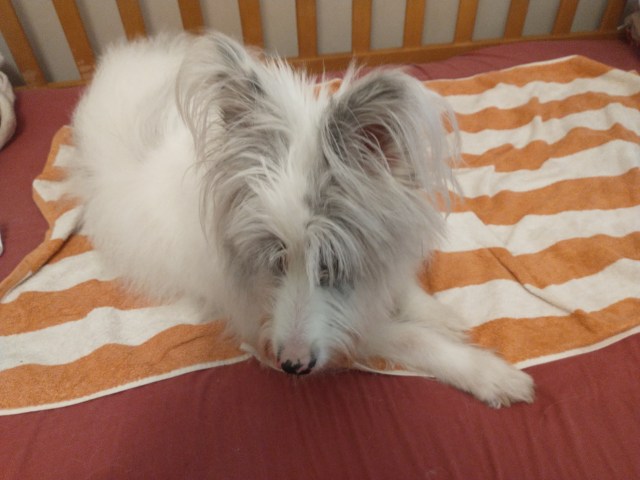
……… all of the articles which I have read so far emphasise that there are only two permissible coat types, and those are smooth or wiry. In fact one writer describing the acceptable breed characteristics of the pequino, states very bluntly that their coats must be wiry or smoothe – never silky !
And heaven forfend that the Portuguese podengo should have an undercoat.
My beautiful Isis, as we know, has a very soft, luxuriously silky coat, and an exotic thermal undercoat.
I wonder whom her mother met while out on an evening stroll!
Isis came from Aeza cat and dog rescue in Aljezur, Portugal. For information about adopting an animal from the centre, contact kerry@azea.org or go to http://www.dogwatch.co.uk.
 Isis, my blind/deaf dog